LUGB Vortex Flow Meter
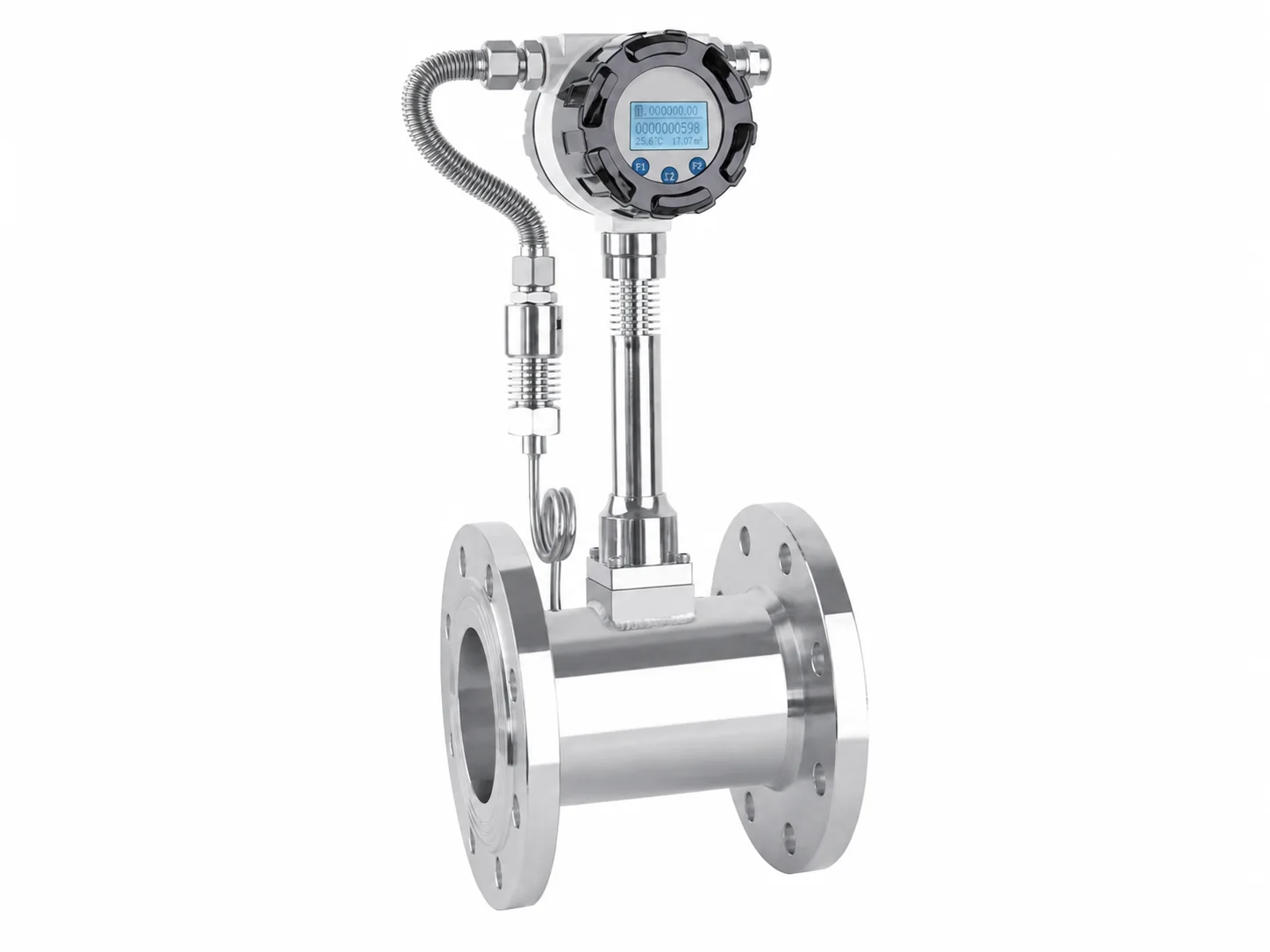
LUGB Vortex Flow Meter
The LUGB vortex flow meter operates on the Kármán vortex principle with no moving parts inside the pipe body. Suitable for metering steam, gases, and low-viscosity liquids. Wide turndown ratio, stable meter factor, and excellent long-term repeatability. Widely used in process measurement and energy metering in chemical, power, thermal, and metallurgical industries.
- Based on Kármán vortex principle, no moving parts in the pipe body, reliable operation with minimal maintenance
- Wide turndown ratio: typical 8:1, up to 40:1
- Stable meter factor, short-term repeatability of 0.05%~0.2%, suitable for custody transfer and online calibration
- Digital signal processing with no zero drift, and specialized filtering against mechanical vibration
- Wide sensor temperature range: -40~350°C with standard options, higher available for special versions
- Integral/remote configurations available, supports multiple connection types and ExdIICT6 explosion-proof and SIL2 certifications
Overview
Product Overview
The LUGB vortex flow meter is a velocity-type flow instrument based on the Kármán vortex principle, widely used for flow measurement, monitoring, and control of liquids, steam, and most gases. The flow body has no moving parts, offering a compact and reliable design. It is available in integral or remote configurations, and supports various connection types including flange, wafer, insertion, threaded, and sanitary clamp to accommodate different piping and operating conditions.
Measurement Principle
A non-streamlined vortex shedder is placed perpendicular to the flow direction inside the flow body. When the measured fluid flows past, alternating vortices with opposite rotation directions are generated on both sides of the shedder in a regular pattern, known as the "Kármán vortex street." The vortex shedding frequency is proportional to the fluid velocity, expressed as f = St · v / d (where St is the Strouhal number, approximately constant over a wide Reynolds number range). The meter converts the vortex pulsation pressure into an electrical signal via a sensor, which is then amplified, filtered, and shaped to output a pulse (or 4–20mA) signal corresponding to the flow rate. Each pulse represents a defined volume of fluid, enabling instantaneous flow and total accumulated volume measurement.
Structure and Performance
The converter employs digital signal processing with zero drift and features specialized filtering to resist mechanical vibration. The sensor is isolated from the process, ensuring a constant meter factor and high repeatability. The wetted parts can be made of 304 or 316 stainless steel depending on medium corrosiveness. Options include high-temperature models, explosion-proof (ExdIICT6), and SIL2 functional safety certification to suit complex conditions in chemical and thermal industries.
Specifications
| Nominal diameter | DN15–DN300 (>DN300 insertion type optional) |
| Accuracy grade | Gas ±1.5%, Liquid ±0.75%, Insertion type ±2.5% |
| Repeatability | ±0.3% |
| Medium temperature | -40~350℃ |
| Ambient temperature | -20~70℃ |
| Applicable medium | Steam / Gas / Low viscosity liquids |
| Flow velocity range | Gas 5~50 m/s, Liquid 0.5~7 m/s |
| Body material | 304 / 316 (selected based on medium corrosiveness) |
| Nominal pressure | 1.6 / 2.5 / 4.0 / 6.3 MPa (customizable) |
| Protection grade | IP65 / IP67 |
| Explosion-proof grade | ExdIICT6; SIL2 certification |
| Power supply | 24VDC or 3.6V battery powered |
| Output signal | 4–20mA / Pulse |
| Communication protocol | RS485 / HART |
| Connection type | Flanged, Wafer, Insertion, Threaded, Sanitary clamp |
| Structure form | Integral / Remote |