LDE Smart Electromagnetic Flow Meter
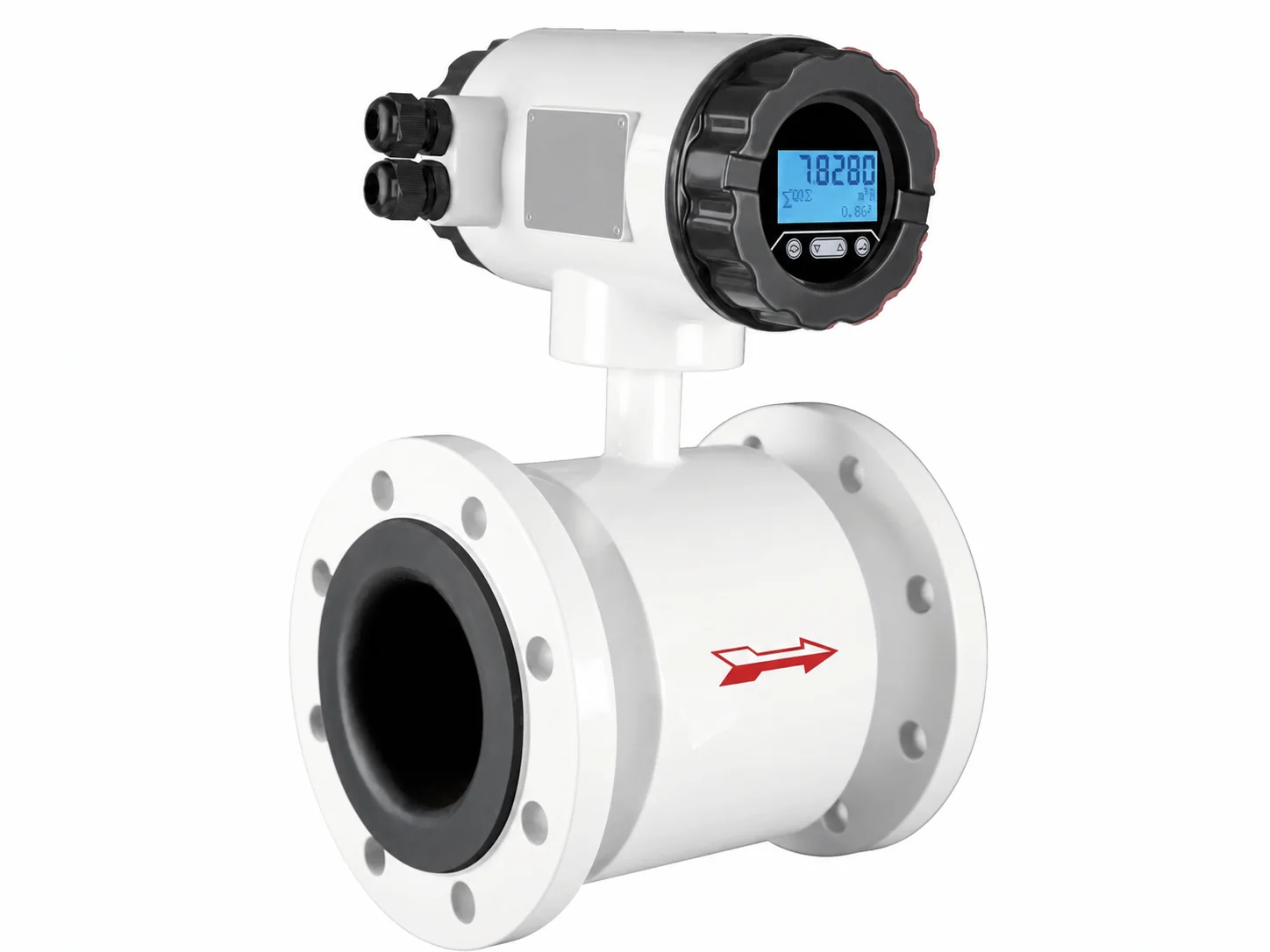
LDE Smart Electromagnetic Flow Meter
LDE Smart Electromagnetic Flow Meter, based on Faraday's law of electromagnetic induction, measures volumetric flow of various conductive liquids (acids, alkalis, salts, pulp, slurry, etc.). No obstruction in the pipe, low pressure loss, high accuracy.
- Faraday's law of electromagnetic induction, no obstruction or moving parts in pipe, low pressure loss, maintenance-free
- Measurement unaffected by changes in fluid density, viscosity, temperature, pressure, and conductivity, high linearity
- Wide nominal diameter range DN6–DN3000, multiple lining and electrode combinations for various conductive media
- Low-frequency rectangular wave excitation, good stability, low power consumption, turndown ratio up to 50:1
- Backlit Chinese LCD, full Chinese character menu, intuitive operation
- Integral or remote type optional, supports RS485/RS232 digital communication
Overview
Product Overview
LDE Smart Electromagnetic Flow Meter is based on Faraday's law of electromagnetic induction. It is used to measure the volumetric flow of various conductive liquids or liquid-solid two-phase media such as acid, alkali, salt solutions, pulp, and slurry. It can be used with display, totalizer, and control devices for detection, totalization, and control. The measuring tube has no obstruction or moving parts, almost no additional pressure loss, and the sensor has a long service life. It is not suitable for non-conductive liquids, gases, or steam.
Measurement Principle
When a conductive fluid flows at an average velocity V through a measuring tube with inner diameter D placed in a uniform magnetic field with magnetic induction intensity B, an induced electromotive force E = B·D·V is generated on a pair of electrodes perpendicular to the magnetic field and flow direction. Since the volumetric flow rate is proportional to the electromotive force, the flow rate can be obtained by measuring the electromotive force between the electrodes. The measurement accuracy is not affected by changes in fluid density, viscosity, temperature, pressure, or conductivity.
Structure and Performance
The converter uses low-frequency rectangular wave excitation, providing good stability and low power consumption. A 16-bit microprocessor handles all-digital processing, and the turndown ratio can reach 50:1. It features a backlit Chinese LCD display with full Chinese character menu. Only the inner lining and electrodes of the sensor contact the medium; by selecting suitable lining and electrode materials, corrosion and wear resistance can be achieved.
Specifications
| Nominal Diameter | DN6–DN3000 (Commonly DN10–DN2000) |
| Accuracy | ±0.5% (±0.3% optional) |
| Turn Down Ratio | 50:1 |
| Applicable Medium | Conductive liquids and liquid-solid two-phase (not applicable to non-conductive liquids/gases/steam) |
| Nominal Pressure | Flange PN1.0–4.2MPa; Clamp PN1.0MPa |
| Lining Material | Rubber / Polyurethane / PTFE / F46 (selected based on medium) |
| Electrode Material | 316L / Hastelloy / Titanium / Tantalum |
| Excitation Mode | Low-frequency rectangular wave excitation |
| Straight Pipe Run Requirement | Upstream ≥5D |
| Explosion-proof Rating | ExdIICT6 |
| Display | Backlit Chinese LCD |
| Output Signal | 4–20mA / Pulse, Frequency |
| Communication Protocol | RS485 / RS232 |
| Structure Type | Compact / Remote |