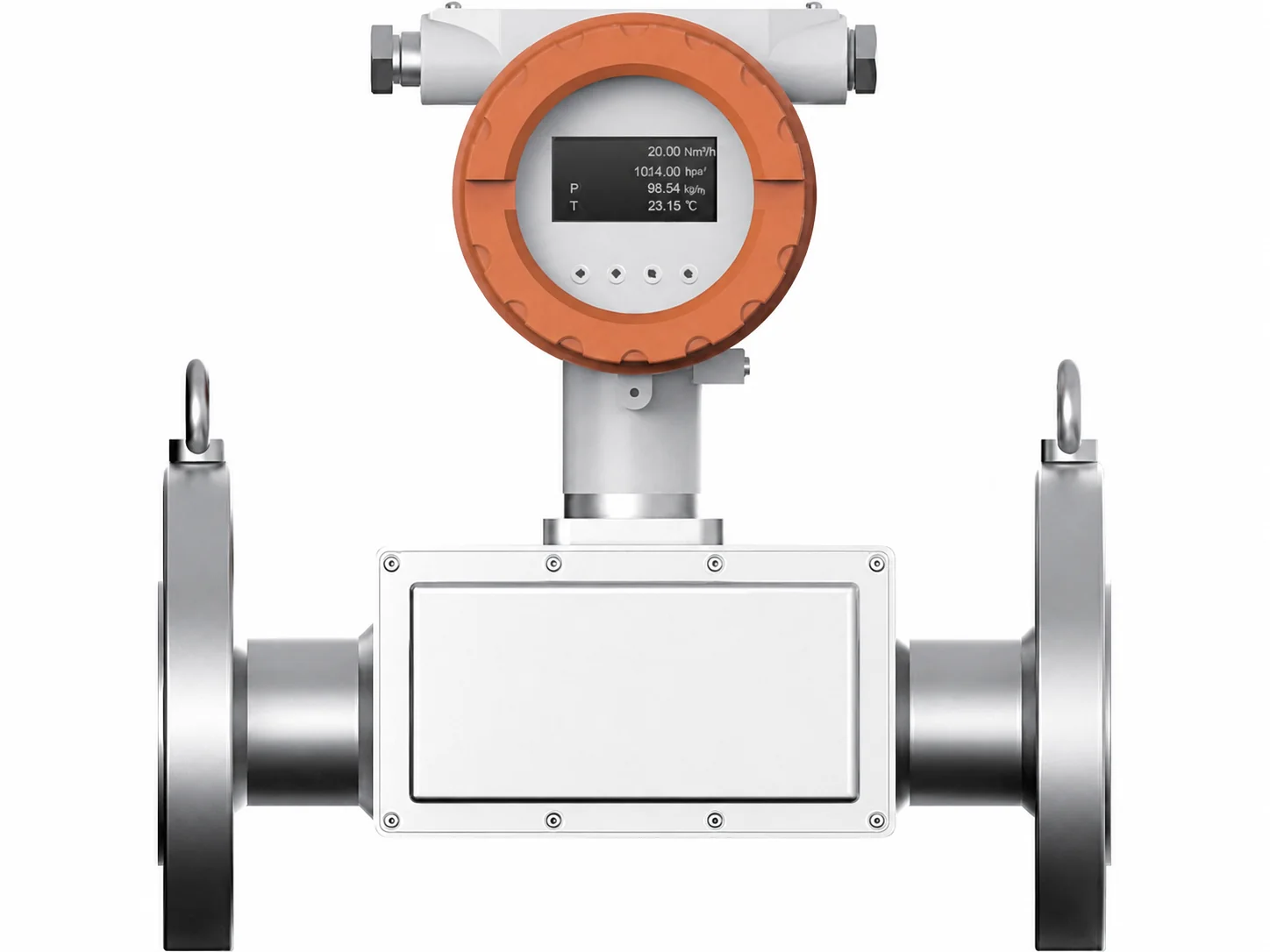
1. Working Principle Differences
Ultrasonic flowmeters measure flow velocity using the transit time difference or Doppler effect of sound waves in moving fluid, applicable to both conductive and non-conductive liquids. Electromagnetic flowmeters are based on Faraday's law of electromagnetic induction and require liquid conductivity ≥5μS/cm.
2. Applicable Media and Conditions
- Conductivity: Electromagnetic flowmeters require conductive media; ultrasonic flowmeters have no such limitation.
- Bubbles or Solids: Doppler ultrasonic flowmeters can measure liquids with bubbles or solid particles, but transit-time method requires clean media; electromagnetic flowmeters are insensitive to bubbles, but solid deposition may affect electrodes.
- Pipe Diameter Range: Ultrasonic flowmeters (especially clamp-on) suit large diameters (DN25~DN5000), while electromagnetic flowmeters typically cover DN10~DN3000.
3. Accuracy and Stability
Electromagnetic flowmeters typically offer accuracy of 0.2%~0.5% reading, less affected by temperature and pressure; ultrasonic flowmeters have accuracy around 0.5%~1.0% reading, more influenced by fluid state and installation conditions. For custody transfer, electromagnetic flowmeters are more reliable.
4. Installation and Maintenance
- Ultrasonic flowmeters (clamp-on) require no pipe cutting, easy installation, but need sufficient straight pipe (10D upstream, 5D downstream); electromagnetic flowmeters require pipe cutting but have lower straight pipe requirements (5D upstream, 3D downstream).
- Electromagnetic electrodes are prone to corrosion and require periodic cleaning; ultrasonic transducer fouling can affect signals.
5. Economic Considerations
For small diameters, electromagnetic flowmeters are more cost-effective; for large diameters, ultrasonic flowmeters (clamp-on) have advantages. Additionally, ultrasonic flowmeters have no pressure loss, offering energy savings.
6. Selection Recommendations
| Condition | Recommended Type |
|---|---|
| Conductive liquid, clean or with few bubbles | Electromagnetic flowmeter |
| Non-conductive liquid (oils, organic solvents) | Ultrasonic flowmeter (transit-time) |
| Large diameter, low pressure loss requirement | Ultrasonic flowmeter (clamp-on) |
| High accuracy for custody transfer | Electromagnetic flowmeter |
A municipal water supply company selected SIENCUN ultrasonic flowmeters for a DN1200 raw water pipeline, replacing traditional electromagnetic flowmeters, reducing installation costs and achieving zero pressure loss. It is recommended to calibrate according to GB/T 18604 (ultrasonic) or GB/T 2624 (electromagnetic) based on specific conditions.